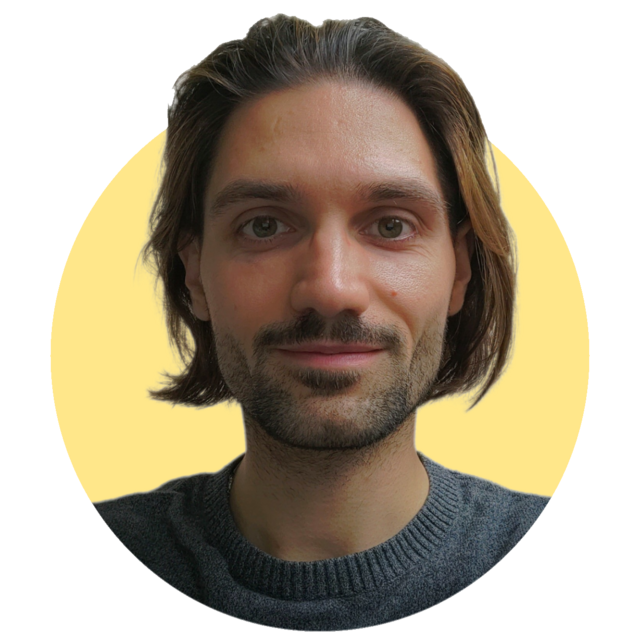
My work spans several connected roles, all sharing a systemic, interdisciplinary mindset.
Nanoscience & Environment Researcher
A master in
Optics and Nanotechnology
gave me a broad overview of nanoscience, from theoretical frameworks to applications.
A PhD in
Nanobiophotonics
then let me build expertise at the interface of nanoscience, biology, and optics.
As a postdoctoral researcher at the
Hubert Curien Pluridisciplinary Institute (IPHC),
within the CO2-InnO Interreg project, I conducted prospective
Life-Cycle Assessment (LCA) studies on the Fessenheim NPP decommissioning, the recycling
of very-low-level radioactive metals, and a micro-CHP demonstrator coupled to hydrogen
production through electrolysis.
I am now a postdoctoral researcher at
LASIRE,
within the CNRS CalcADN project,
running a prospective LCA study of emerging DNA-computing technology – bringing together,
for the first time, my experience in both nanobiosciences and sustainability.
Participative Action Research
A growing part of my work is about how to design settings where researchers,
institutions, and citizens take part in producing and debating knowledge – and turning
that deliberation into action.
I co-organised the
IESF 2025 Scientists Assembly
on the relations between research and the civil, industrial, and political spheres,
bringing PhD holders and candidates from every scientific field together, to formulate recommendations on how to bring science and society closer.
Since the assembly's report, we run restitutions and workshops in varied settings –
research labs, public institutions, science-mediation associations, and political
parties – to open debate and work towards operationalizing the recommendations. In
parallel, we began reflexive scientific studies of the deliberative process itself.
This collective work builds on the project- and team-management experience I have
gathered across research, associative events, and first-aid services.
R&D Engineer
My engineering degree in
Materials: Technology & Economy
from the
University of Technology of Troyes (UTT)
led to two R&D internships and a PhD. My first experiences in industrial research at
CEA Tech
taught me to work autonomously and to keep short- and long-term technical feasibility in mind.
From the structural properties of matter and light–matter interactions, to Life-Cycle
Assessment, eco-design and materials for energy and optoelectronics – plus fluent use of
varied software and insights from the sociology
of organisations and the history & philosophy of science – I bring the profile of a
reflexive engineer with a systemic, interdisciplinary mindset.
Physics & Ecology of Materials Teacher
Alongside research, I supervised practical work in physics & chemistry as a teaching
assistant in 2020–2021 at the
University of Technology of Troyes.
I also designed and taught a section on abiotic resources within a general course on
modelling Human–Systems–Nature interactions, studying current production and consumption
and their futures through a sociotechnical lens.
(resources slides,
modelling slides).
Arts Enthusiast
The collective effort of making art is one of my greatest pleasures – talking, acting,
directing, or writing.
During my university years I wrote, directed and edited a short film, and was involved in
the Ch'UTT de vers
company (four plays as actor, one as co-writer, two as director). I have since performed with
the Compagnie Grande,
and co-wrote, directed and produced a spatialised audio fiction with the new
B329 company, releasing in 2026.